Understanding Martyn’s Law: A New Terrorism Protection Legislation in the UK

On April 3rd, 2025, the UK government passed the Terrorism (Protection of Premises) Act 2025, more widely known as Martyn’s Law. Martyn’s Law is a new law aimed at improving public safety in venues across the UK. It requires venues and public spaces to take steps to prevent and prepare for terrorist attacks. The law will be enforced by the Security Industry Authority (SIA), and over the next two years, premises across the UK will begin preparing to meet their new legal responsibilities under this law.
What is Martyn’s Law?
On April 3rd, 2025, the UK government passed the Terrorism (Protection of Premises) Act 2025, more widely known as Martyn’s Law. Martyn’s Law is a new law aimed at improving public safety in venues across the UK. It requires venues and public spaces to take steps to prevent and prepare for terrorist attacks. The law will be enforced by the Security Industry Authority (SIA), and over the next two years, premises across the UK will begin preparing to meet their new legal responsibilities under this law.
Why has Martyn’s Law been introduced?
The Manchester Arena attack, which happened on May 22nd, 2017, exposed significant gaps in venue security and preparedness. Despite credible threats and a high footfall of vulnerable people, many of them children, there was little to no formal process in place to mitigate the risk of a terrorist attack.
Martyn’s Law aims to fix that. It ensures that all public venues take reasonable steps to protect the people who use them from the threat of terrorism.
Martyn’s Law will apply to a range of public venues, from bars and community halls to large stadiums, concert arenas, and shopping centers. The law applies across England, Scotland, Wales, and Northern Ireland, and will be introduced as a two-tiered system based on the capacity of a venue:
- Standard Tier (100-799 capacity): Venues will be required to undertake simple, low-cost activities like basic staff training, emergency planning, and also consider installing a critical alert system, such as visual or audible lockdown signals. This tier will also apply to all schools and places of worship – regardless of capacity.
- Enhanced Tier (800+ capacity): Larger venues must meet more rigorous requirements, including formal and detailed security risk assessments, a higher level of staff training, robust security plans, and physical security measures such as CCTV, bag and vehicle checks. There will be high penalties for organisations that do not comply. This may be up to £18 million or 5% of global turnover.
Lockdown Alerts: A Key Focus for Schools
An important recommendation for schools is to install an alarm system that complies with guidelines from NaCTSO, which states ‘use of fire alarms should be avoided to reduce incorrect response to an incident’. This helps avoid confusion between a fire evacuation and a "stay-put" response during a security threat.
One effective solution already in use at school sites in the UK is the Luminite Alertex Wireless Critical Alert System. This battery-powered, wireless system features flashing lights and an audible alert. It can be activated remotely, either through a key fob or from a central control point, offering a flexible and reliable way to quickly warn people of a security threat.
Alertex units are designed for quick installation and to minimise disruption to the learning environment. Alertex provides audible and visual alerts for pupils and staff, clearly distinguishable from fire alarms.

When one Alertex device is activated, it automatically triggers all units within range to emit an audible alert or lockdown message, along with a flashing beacon light. The range includes both Indoor and outdoor models, and the volume can be adjusted to suit the environment. There is also the option to choose from 32 different alert sounds or opt for an annunciator version, which includes a built-in strobe light and a standard lockdown message. Schools also have the option to record and use a custom message if preferred.
Alertex Lockdown - School Installation
Alertex Lockdown Features
Award-Winning Mass Communication Solution from Audiebant
Another essential security solution to consider is Audiebant, the UK’s leading specialist in audio, visual, and mobile communication technologies. Audiebant serves a wide range of sectors, including Education, the NHS, Local Government, and Corporate environments.
The Audiebant system is a fully integrated solution designed to deliver mass communication through audio, visual displays, and mobile devices, ensuring complete site coverage. It provides calm, clear, and concise instructions to individuals on-site, guiding them to safety or outlining exit strategies based on the nature of the emergency.
The system supports internal and external zoning, including areas such as car parks. Alongside audio alerts, Audiebant offers software capable of displaying lockdown messages across an unlimited number of screens. Its mobile app, Audisafe, enables staff, students, and site visitors to receive emergency alerts directly on their smartphones.
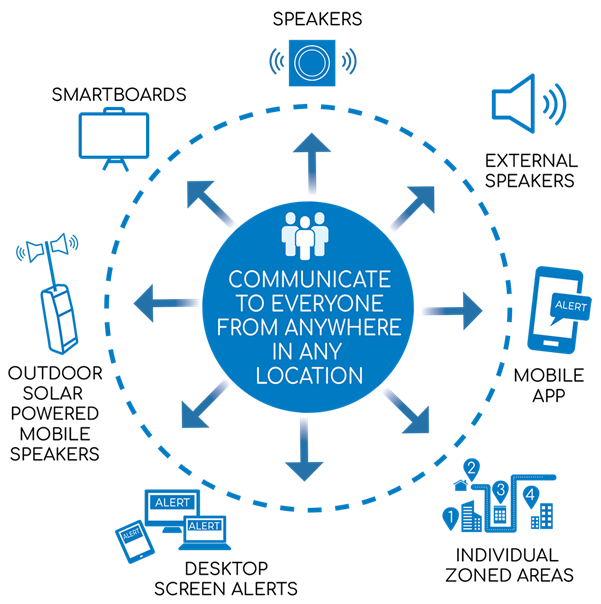
Messages can be delivered instantly or scheduled as pre-recorded announcements, with authorised users able to update them as needed. Beyond emergency use, the system is also ideal for daily communication—handling routine announcements, visitor greetings, promotional messages, and other broadcasts.
Audiebant provides a complete solution package, including system supply, professional installation, user training, and content creation.
Protecting people is no longer optional—it’s the law
Martyn’s Law marks a pivotal change in how the UK approaches public safety, placing a legal duty on venues to take proactive measures against the threat of terrorism. By introducing a structured, tiered system, the legislation ensures that venues of all sizes—from schools and community centres to major event spaces—are prepared to protect lives in the event of an attack.
Implementing clear communication systems, such as the Luminite Alertex and Audiebant solutions, can play a vital role in meeting these new responsibilities. These tools not only support compliance with Martyn’s Law but also help create safer, more responsive environments for the public, staff, and students.
As the rollout of this legislation begins, now is the time for organisations to evaluate their security strategies, invest in the right technologies, and commit to a culture of preparedness.
Call Norbain today to see how we can assist you with Martyn's Law compliance.